
Why Your Business Idea Isn’t Gaining Traction : and Why It’s Not Your Work Ethic
If your business idea is not gaining traction, your next decision is not automatically to work harder.
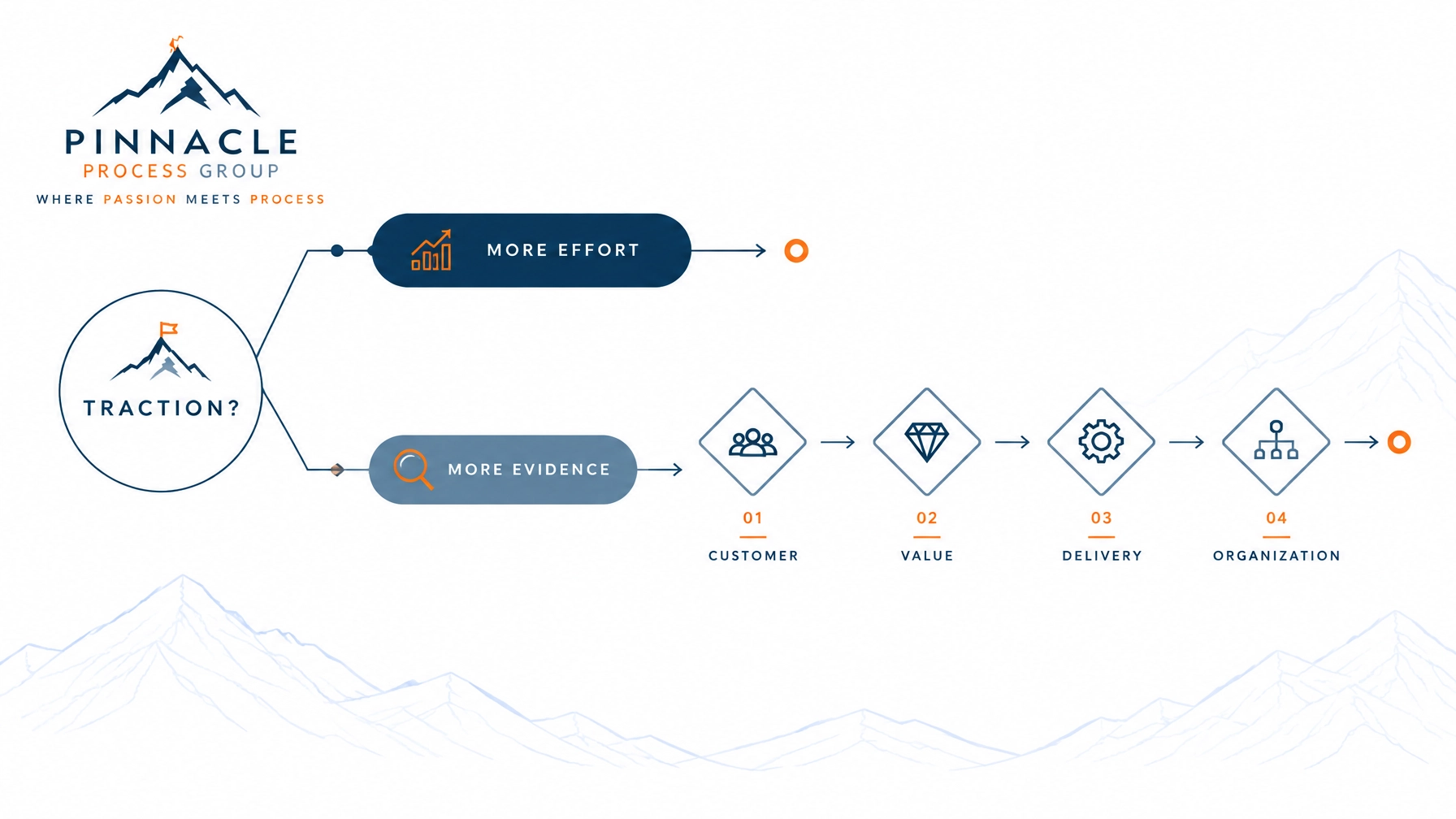
It is to determine whether the market needs more effort from you: or whether you need better evidence before spending more cash, time, and energy.
That distinction matters for every founder. It matters even more for first-generation entrepreneurs who are building without inherited systems, family capital, or a financial cushion.
A Fortune 500 enterprise can absorb a failed product launch because it may have established processes, specialized teams, operating data, and cash reserves. A veteran investing a separation payment, a single mother using household savings, or a displaced worker betting severance may not have the same room for error.
You were told to “just go for it.” That advice leaves out the operating structure that makes calculated experimentation possible.
When traction is weak, the answer is not to question your work ethic first. The answer is to identify the constraint.

The decision: push harder or validate market fit?
There are two reasonable responses to weak traction:
- Increase activity: more marketing, more outreach, more features, more hours.
- Step back and test whether the right customer wants the right offer badly enough to act.
Both approaches can be appropriate. The mistake is choosing between them based on emotion, pride, or momentum instead of evidence.
If customers understand the offer, respond consistently, buy, return, and refer others, the business may need stronger execution. More disciplined sales activity or improved delivery could be the right move.
If people show polite interest but do not commit, the problem may be earlier in the system. You may be targeting the wrong customer, solving a low-priority problem, describing the value poorly, or offering something that cannot yet be delivered reliably.
Those are operating problems. They require diagnosis before acceleration.
Why weak traction is often a market-fit problem
CB Insights analyzed 431 VC-backed companies that shut down since 2023. In its analysis, 43% cited poor product-market fit as a primary reason for failure. “Ran out of capital” appeared in 70% of cases, but capital often became the final symptom rather than the original cause.
The distinction is important. A business can spend months or years covering up weak demand with additional effort. More activity may create more conversations, but not necessarily more customers.
The CB Insights analysis also notes that many failed companies cited multiple causes. Market fit, timing, and economics can interact. A weak offer may require expensive customer acquisition. Expensive acquisition can exhaust cash. Limited cash can prevent the founder from improving the offer.
The cycle is operational, not moral.
Startup Genome found a related pattern in its analysis of more than 3,200 high-growth technology startups. Its research identified premature scaling as a major failure pattern and reported that 74% of high-growth startup failures were associated with premature scaling.
The Startup Genome research was focused on high-growth technology startups, not every small business. That scope matters. Still, the operating lesson is useful: scaling customer acquisition, product development, hiring, or fundraising before the business has enough evidence can increase the cost of being wrong.
Common approaches to weak traction
Approach 1: Work longer hours
This can help when the constraint is execution capacity.
For example, if customers are buying but follow-up is slow, the founder may need a better sales process. If orders are coming in but fulfillment is inconsistent, the business may need documented delivery steps.
More effort is useful when the underlying direction has evidence behind it.
It is not a substitute for evidence.
Approach 2: Spend more on marketing
Marketing can improve reach and clarify an offer. It cannot create durable demand where the problem is not important enough to solve.
If paid advertising produces clicks but no qualified conversations, the issue may be the message, audience, offer, or problem itself. Increasing the budget before identifying the constraint makes the test more expensive without making it more useful.
Approach 3: Build more features
Product development feels productive because it creates something visible.
But new features do not prove that the original customer, problem, or buying decision is correct. In some cases, building more makes the offer harder to explain and the business harder to operate.
A useful product test is not “Can we build this?” It is “Will the customer use it, pay for it, and continue to choose it?”
Approach 4: Keep waiting for traction
Patience is not the same as passivity.
Some markets require time. Some sales cycles are long. But waiting without defining what evidence would change the decision turns patience into drift.
A founder should be able to state what must happen in the next 30, 60, or 90 days to justify continued investment.
The enterprise perspective: find the bottleneck before adding force
Enterprise operations teams do not usually respond to a missed target by telling everyone to try harder. They identify the process constraint.
A simple DMAIC lens helps:
- Define: What decision are you trying to make? Continue investing, change the offer, change the customer, or stop?
- Measure: What is actually happening? Track conversations, qualified responses, proposals, purchases, repeat use, delivery time, and cash consumed.
- Analyze: Where does the process stop working? Is the bottleneck awareness, trust, willingness to pay, conversion, delivery, or repeat demand?
- Improve: Test one focused change at a time.
- Control: Create a simple review point so the business does not drift back into assumption.
The bottleneck may not be where the founder is spending the most time.
A founder may be working twelve-hour days on product development while the real constraint is that the target customer does not recognize the problem. Another may be increasing outreach while the offer is too broad to create a clear buying decision.
This is where opportunity cost matters.
Every dollar spent on premature advertising is a dollar unavailable for customer research, delivery improvements, or cash reserves. Every month spent building an unvalidated feature is a month not spent testing a simpler offer. Every new commitment adds operating complexity.
The question is not whether you are working hard. The question is whether your work is reducing the uncertainty that matters most.
A practical first-time founder roadmap
Use this four-part review before committing more resources.
1. Customer: Can you identify the buyer specifically?
Do not begin with a broad demographic description.
Name the type of person or organization that has the problem, has the authority or ability to act, and can be reached through a realistic channel.
Then speak with them. Ask what they currently do, what the problem costs them, what they have already tried, and what would make a solution worth paying for.
A conversation about your idea is not the same as evidence of demand. Look for specific behavior, not encouragement.
2. Value: Is the problem important enough to change behavior?
A customer may agree that a problem exists and still do nothing.
Test whether the problem is urgent, expensive, frequent, visible, or connected to a meaningful outcome. Ask what happens if the customer does not solve it.
Your value proposition should explain why the customer would choose your offer over existing alternatives, including doing nothing.
3. Delivery: Can you fulfill the promise now?
Before investing in scale, deliver a small version of the offer manually or through a limited pilot.
Document what was promised, what was delivered, how long it took, what it cost, and what the customer valued. A real transaction teaches more than a polished plan.
If you cannot deliver consistently to three customers, adding thirty more creates a larger operating problem.
4. Organization: Can the business support the next step?
Review cash, capacity, tools, responsibilities, and basic processes.
Do not ask whether the business is ready to become large. Ask whether it is ready for the specific next commitment under consideration.
That may be a small marketing test, a contractor, inventory, software, or a new sales channel. Tie the investment to a defined evidence threshold and a review date.

Decision summary
If the business has repeatable customer response and a delivery process that works, push harder with discipline.
If traction is inconsistent, interest is mostly verbal, or the offer keeps changing, step back before spending more. Validate the customer, value, delivery, and operating requirements in that order.
Your work ethic is not the diagnosis.
It may be helping. It may be compensating for a weak assumption. It may be consuming resources that should be used to learn.
The next step is not to prove that you can suffer longer. It is to make the next investment based on evidence.
Your next step
You don’t need more advice. You need sequence. Take the free 3-minute A.I.D.A. Lite assessment at pinnacleprocessgroup.com and get a Founder Action Plan tailored to where you are right now.
Continue Your Journey
Use the path that matches the decision in front of you:
- Free Tools : practical tools for testing an idea, understanding the market, and choosing a next step.
- Get Connected : workshops, community, networking, and peer support.
- Support Suite : ongoing business-specific decision support with context and continuity.
- Get Guidance : direct guidance when you need experienced perspective on the business in front of you.
- Full Engagement : a structured path for business-wide assessment, planning, and implementation.