Stop guessing. Start building.

Turn the business in your head into something real.

We bet we can guess what led you here.

You're trying everything you can think of... YouTube. AI. The Facebook group, the subreddit, the course that promised to make it click. Maybe someone in your circle who built something real. You can see yourself at the pinnacle, they're all promising they know the way. And yet, something is still off. Not dramatically — just enough to feel it. The advice is everywhere and none of it fits quite the way it was sold.

That gap you feel has a name. And it has a solution that many startup founders have never had access to.

You Are Here

Every successful business looks like proof that the visible things work — the website, the branding, the launch, the presence. So that is where most founders start: building what they can see, in the order they see it.

What they are looking at is the output. What made it possible is underneath — and nobody shows you that part.

The advice What you see What you don't
"Just get it out there" The launch. The momentum. The founder who moved fast and built something real. The customer research that happened before a single dollar was spent. The confirmation that someone would actually pay for it.
"Fail forward" The pivot story. The founder who tried ten things and found the one that worked. That most of those attempts had a runway to absorb the cost. Failure is only data if you can afford the experiment.
"Find what works" The business that tested, iterated, and landed on something that stuck. That what works in another market, for different customers, at a different moment, tells you nothing about yours.
"Trust your gut" The conviction. The founder who believed before anyone else did and turned out to be right. The gut had evidence behind it. Years of market exposure and customer contact — not instinct. Instinct dressed up in hindsight.
"Follow your passion" Musk. Zuckerberg. Jobs. The relentless energy of someone who believed completely in what they were building. Passion was the fuel. Structure was the engine. Every one of them knew precisely who they were building for and why. That part was never in the advice.

No established business operates on this advice. No franchise opens a location by trusting its gut. No product team fails forward with the company's last available capital. This advice exists because the structured alternative was never made available to the founders who needed it most.

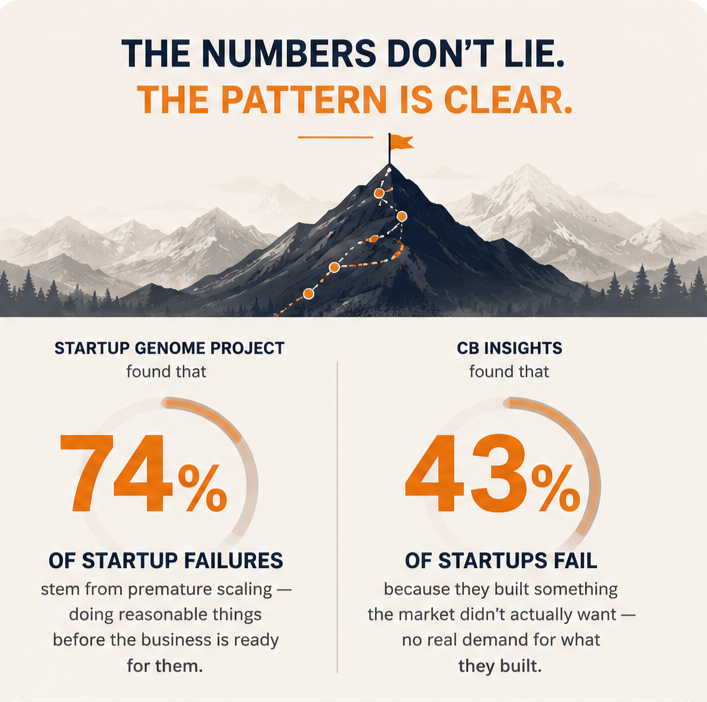
The data is consistent. 42% of businesses fail because they never confirmed there was a real market for what they built. Another 29% run out of cash.1 Those are not two different problems. They are the same problem — money and effort spent before the market was understood. Nearly half of all new businesses are gone within five years.2

This is not a motivation problem. It is an access problem. The structured thinking that prevents these mistakes exists — it is standard operating procedure inside every organization large enough to afford the people who know how to do it. Lean Six Sigma consultants who run this kind of analysis bill at $1,500 to $3,500 per day.3

That price tag does not reflect the complexity of the knowledge. It reflects who has historically been allowed to benefit from it.

The startup founder has been priced out. Not because the thinking does not apply to a business of their size — it applies more critically, because there is no margin for the mistake it prevents. A Fortune 100 company absorbs a failed product launch and moves on. The founder who spends her last $2,500 on an ad spend she did not need does not get to write it off.

The structure

Every successful business is built on four things.

Not vision. Not hustle. Not funding. Four specific things, in a specific order, grounded in evidence rather than assumption. This is not proprietary knowledge — it is what every business that survives long enough to look successful has figured out, one way or another. The difference is whether you figure it out before you spend the money, or after.

01

Who they are for

Not "anyone who needs it." A specific person with a specific problem — understood precisely enough to find them, speak to them, and build for them.

02

What that person is up against

The real reason they are looking for a solution. The burning thing that does not go away on its own — in their language, not the founder's interpretation of it.

03

What solves it

Not the full vision. The simplest version of what the business offers that actually addresses the need — defined before anything is built or spent.

04

How it gets delivered

Consistently. Repeatedly. In a way the business can stand behind — with a process that does not depend on improvising every time.

That sequence is the structure underneath every launch worth studying. Most founders have pieces of it. Almost none have all four, built on real evidence, in that order.

The sequence is not complicated. Getting honest about where you actually are in it is. That is where the work begins.

Why PPG

Built for the founder who has been priced out.

PPG was founded by someone who spent 20+ years inside the kind of organizations that take structured thinking for granted — Caterpillar, Carrier, WellPoint. Lean Six Sigma. Enterprise operating systems. The methodology that turns assumptions into evidence and chaos into repeatable process.

When that career gave way to entrepreneurship, the gap was immediate and visible. No data. No structured diagnostic. The support available was either motivational or disjointed — and the advice from peers in the field was straightforward: go where the real money is. Find clients with the budgets to match the methodology. Seven-figure engagements. High-ticket retainers.

That advice was not wrong. It just was not the point.

The founders who needed this thinking most were the ones who could not afford it. Not because the methodology was too sophisticated for a business their size — but because nobody had ever bothered to make it accessible to them. That is not a market gap. That is a decision someone made, and kept making, for a long time.

PPG exists to make a different decision.

The climb is real. You should not have to make it without the right footing.

Sequence matters

Advice is everywhere. Alignment is rare.

All the steps in baking a cake are correct. The sequence matters.

Two cakes side by side. On the left, a sunken homemade cake — the result of steps done out of order. On the right, an evenly risen cake finished with berries — the same ingredients, the right sequence.

You can buy the recipe. You can ask AI for the steps. You can watch every video and call everyone who has baked before. Every piece of that advice can be correct. None of it tells you what comes first for you.

That sequencing — what to do now, what to wait on, what to skip entirely — is the work. It does not happen by accident. It has to be built on an honest picture of where you actually are.

Start the conversation

If any of this sounds like where you are, let's talk.

Not a sales call. A real conversation — about where your business actually is, what is working, what is not, and what probably needs to happen first.

No obligation. No package to pick. If what you read here resonates, that is enough to start.

  1. 1. CB Insights, The Top 12 Reasons Startups Fail. cbinsights.com
  2. 2. U.S. Bureau of Labor Statistics, Business Employment Dynamics, 2024. bls.gov
  3. 3. 6Sigma.us, Lean Manufacturing Costs, 2025. 6sigma.us