
The Support You Need Exists. It Just Wasn’t Built for a Business Your Size.
Sunday's Gap in Options series: where the available choices fail early-stage founders.
The decision is not, “Which support option is best?”
The better decision is: Which support option was built for a business like mine?
That distinction matters because most available support is not designed for an early-stage business with real customers, limited cash, changing priorities, and too little repeatable work to justify a full-time operator.
The options are not necessarily bad. They are aimed at different buyers.
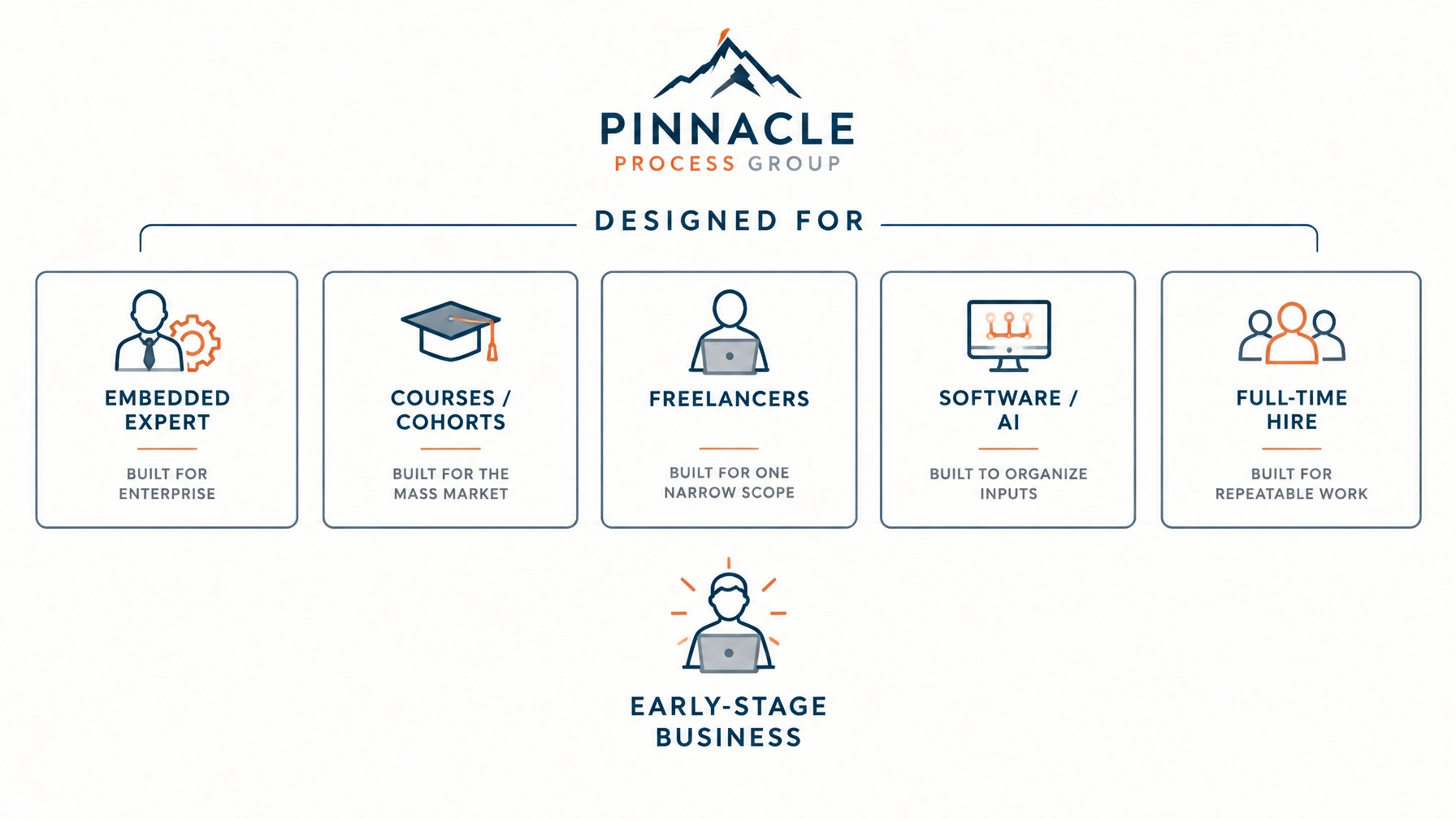
Enterprise consulting is built for large organizations with budget, defined scope, and authority to act. Courses and cohorts are built for a mass audience. Freelancers are built for narrow assignments. Software and artificial intelligence tools are built to organize information. Full-time hires are built for a stable body of work that repeats.
An early-stage founder often sits outside all five designs.
That is the gap in options. It is structural, not a failure of effort or ambition.

What the market is actually offering
1. Embedded experts: designed for enterprise buyers
The closest match to what many founders actually need is an experienced operations leader who can work inside the business, understand the context, and design practical solutions around the company that exists.
That is the right kind of support.
It is also usually priced for a larger organization. Enterprise buyers can fund a consulting engagement, define a workstream, provide internal teams, and absorb a substantial professional-services bill. They may have a mandate for process redesign, a transformation budget, and executives who can remove barriers.
A very small business may need the same quality of thinking without having the same budget, infrastructure, or scope.
The mismatch is not the expertise. It is the commercial model.
2. Courses, cohorts, and content libraries: designed for the mass market
Courses and cohorts make useful knowledge more accessible. The Small Business Administration, for example, provides guidance on market research, business planning, financial projections, and organizational structure through its business planning resources.
The limitation is context.
To serve thousands of people, a course must simplify. It cannot know your sales cycle, delivery constraints, customer language, cash position, supplier relationships, or competing priorities. It can explain what a business plan should contain, but it cannot determine which assumption in your plan is most dangerous this week.
The lean startup methodology is valuable when you need to test an uncertain assumption. But the method still requires judgment about which assumption matters, what evidence is sufficient, and what the result means for your particular business.
General advice can be credible and still be difficult to apply.
3. Freelancers and specialists: designed for one narrow scope
A freelancer can solve a defined problem well.
You can hire a designer to improve a website, a bookkeeper to organize records, a marketer to launch a campaign, or an analyst to build a dashboard. This is useful when the problem is genuinely contained.
Early-stage businesses rarely have problems that remain contained.
A pricing decision affects marketing. Marketing affects delivery volume. Delivery affects staffing and cash. Staffing affects the customer experience. A specialist may complete the assigned work while no one owns the connection between the pieces.
The result is activity without an accountable view of the whole system.
4. Software and AI tools: designed to organize inputs
Software can provide structure. AI can summarize information, produce drafts, compare options, and make a process easier to repeat.
But a tool generally works from what you provide. It does not automatically know whether your information is incomplete, whether your assumptions conflict, or whether the most important issue is missing from the screen entirely.
A dashboard can show that leads declined. It may not tell you whether the cause is customer targeting, unclear value, inconsistent follow-up, or limited delivery capacity.
Software is useful after the business question is clear. It is less useful when the primary need is diagnosis.
5. Full-time hires: designed for repeatable work
A full-time hire makes sense when there is enough stable work to justify the role.
The organization must be able to explain what the person will own, what decisions they can make, how success will be measured, and how their work connects to the rest of the business. Without that clarity, the business is not hiring a role. It is hiring someone to discover the role while being paid as though the role already exists.
That can be an expensive form of organizational design.
The issue is not that early-stage businesses should never hire. The issue is timing. A full-time position is a commitment to a recurring workload, not a substitute for identifying what the workload should be.
The enterprise perspective: diagnose the mismatch before adding support
An enterprise operations leader would not begin by selecting a tool or assigning a person. The first step would be to define the problem.
A practical DMAIC sequence helps:
- Define: What decision is blocked?
- Measure: What evidence exists about the current condition?
- Analyze: Where is the constraint or bottleneck?
- Improve: What is the smallest change that could improve the decision or flow of work?
- Control: How will the business know whether the improvement is holding?
This approach prevents a common error: adding support to the most visible problem instead of the limiting one.
Suppose a founder believes the business needs more marketing. A DMAIC review may show that new leads are already arriving, but the business has no consistent follow-up process. More marketing would increase the volume of an unresolved sales bottleneck.
Or suppose the founder wants to hire an operations manager. The analysis may show that the business does not yet have a repeatable service process for the manager to own. The opportunity cost is not only salary. It is the time spent managing an unclear role, redesigning it repeatedly, and postponing the decisions that would make the role useful.
Research supports the importance of this sequence. CB Insights’ analysis of 431 venture-backed companies that shut down found that running out of capital was the reported final cause in many cases, while poor product-market fit, timing, and unsustainable economics pointed to deeper problems. Its analysis is a reminder that the visible failure is often downstream of an earlier unresolved condition.
Startup Genome’s Premature Scaling research similarly examined how businesses can expand one dimension (such as headcount, product scope, or customer acquisition) before the rest of the business is ready.
Harvard Business Review’s “Why Start-ups Fail” describes related patterns: false starts, flawed strategies, and the inability to turn early progress into a business that can operate profitably at greater scale.
The lesson is not to avoid support. It is to match support to the condition that actually limits the business.
A practical fit framework for early-stage businesses
Before choosing a support option, assess the business through four connected dimensions.
1. Customer
Can you identify the specific customer you are serving today?
Look for evidence in actual conversations, transactions, referrals, repeat behavior, and objections. A broad audience description is not enough. You need to know who is most likely to recognize the problem and act on it.
If the customer is unclear, a mass-market course may give you concepts, but the next step is focused discovery, not more content.
2. Value
Can the customer explain why they would choose your offer over alternatives, including doing nothing?
This is where strategic business planning often becomes more useful than a polished document. The question is not whether your plan sounds logical. The question is whether the value is clear in the customer’s words and supported by behavior.
If the value is uncertain, more software will not resolve it. You need evidence and a specific decision about what to test.
3. Delivery
Can you reliably fulfill what you promise right now?
Review the actual path from sale to completion. Identify delays, rework, handoffs, quality issues, and work that depends entirely on the founder.
This is where business operations consulting can create value, but the work must be scaled to the business. The immediate need may be a simple delivery map and one improved handoff, not an enterprise transformation program.
4. Organization
Does the structure underneath the work support the next decision?
Clarify who owns each recurring responsibility, what information is required, which decisions remain unresolved, and where the founder is still compensating for missing structure.
This dimension is central to operational excellence for startups. Operational excellence does not mean creating layers of process. It means making the work visible enough to improve without creating unnecessary overhead.
These four dimensions (Customer, Value, Delivery, and Organization) are the foundation of PPG’s RMAE™ methodology. They should mature together. A strong offer cannot permanently compensate for unreliable delivery. More demand cannot compensate for unclear value. Better tools cannot compensate for an undefined customer.

How to choose support without forcing a fit
Use these questions before selecting a provider, program, or tool:
-
What specific decision must improve?
Avoid choosing support because it appears comprehensive. Start with the decision. -
Is the constraint judgment, capacity, coordination, or diagnosis?
Each requires a different kind of help. -
Does the support preserve business context?
If you must explain the company from the beginning every time, the support may not become more useful over time. -
Who owns the connection between the parts?
If several specialists are involved, identify who is accountable for the system rather than one task. -
What evidence will show that the support worked?
Define a measurable change: shorter delivery time, clearer qualification, fewer missed follow-ups, a repeatable process, or a decision made with stronger evidence.
For founders who need ongoing context, continuity, and practical decision support, but are not ready for an embedded enterprise operator, PPG’s Support Suite is the most appropriate fit. It combines decision guides, saved business context, prior decisions, and a CEO Control Panel so the founder can work from a clearer view of the business instead of restarting every question from zero.
The decision summary
The right question is not whether expert advice, education, specialists, software, or hiring has value.
Each does.
The decision is whether the option was designed for your current business.
- Choose embedded expertise when the scope, budget, and authority support it.
- Use courses and cohorts when the main need is foundational knowledge.
- Use specialists when the work is genuinely narrow and clearly defined.
- Use software when the question is clear and the business needs organization or repetition.
- Hire full-time when a stable body of work already exists.
- Use context-preserving decision support when the business is real but still forming its systems, roles, and priorities.
That is the missing middle: support that is specific enough to be useful, structured enough to be repeatable, and sized for the business that exists today.
Continue Your Journey
Ready to stop cycling through generic advice? Take the free A.I.D.A. Lite assessment at pinnacleprocessgroup.com. Your report will show you exactly where to focus next, then register for the next Basecamp Workshop or email your questions to admin@pinnacleprocessgroup.com.