The Business Advice Gap: Why Context Is the Strategy
Founder Gap: Sunday Gap in Options
The decision is straightforward:
When you need operational guidance, should you pay for an embedded expert or continue piecing together advice yourself?
An embedded operations expert is usually the better option. They can see the whole business, identify the constraint, design a solution around your resources, and stay involved long enough to see whether the solution works.
The problem is price.
For many early-stage founders, a full-time operator or high-touch business operations consultant is out of reach. The alternative is do-it-yourself research: books, podcasts, courses, templates, newsletters, and online advice.
That creates the business advice gap.
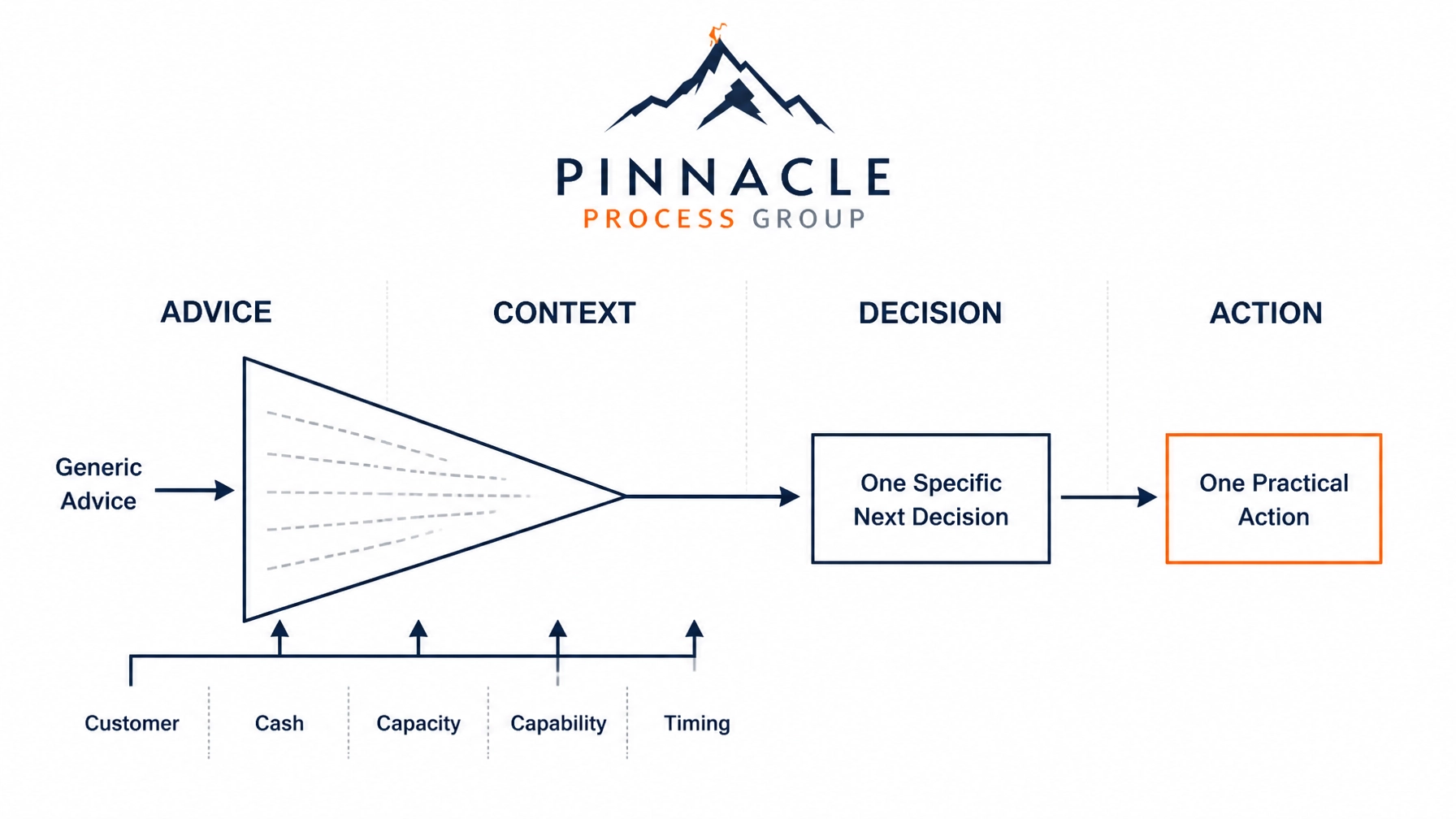
You have access to more credible information than ever. But you do not necessarily have the context required to apply it.
And without context, even good advice can produce the wrong decision.
The advice is not the strategy
A founder can find credible guidance on nearly any business question:
- How to build a strategic business plan
- How to use lean startup methodology
- How to improve sales conversion
- How to create a small business growth strategy
- How to document processes
- How to prepare for hiring
- How to improve operational excellence for startups
The advice may be accurate in general. That does not make it correct for your business today.
Consider three common recommendations:
- Launch a minimum viable product quickly.
- Build repeatable systems before you grow.
- Focus on sales and customer acquisition.
All three can be sensible. They can also conflict.
If you have no evidence that a specific customer wants the offer, building systems may formalize the wrong work. If customers are already waiting and delivery is inconsistent, pushing harder on sales may increase complaints and rework. If demand is proven but cash is tight, hiring may create a fixed-cost problem before revenue catches up.
The recommendation changes when the facts change.
That is why context is not a supplement to strategy. Context determines which strategy applies.

Why generic advice fails in practice
Generic advice usually omits the variables that make a decision specific.
At minimum, a useful recommendation needs to account for:
- Customer: Who is buying, and what problem are they paying to solve?
- Value: Why do they choose this offer instead of an alternative or doing nothing?
- Delivery: What can the business reliably fulfill right now?
- Organization: What people, tools, cash, and processes support delivery?
- Timing: What must be decided now, and what can wait?
Remove those variables and advice becomes a list of possible actions.
The founder still has to decide which action matters, what sequence makes sense, what evidence is sufficient, and what trade-off the business can afford.
That is the work generic content cannot complete.
The data supports the importance of making decisions against actual business conditions. In its analysis of 431 VC-backed companies that shut down, CB Insights identified poor product-market fit, bad timing, and unsustainable unit economics among the reported causes of failure. The analysis does not prove that better advice alone would have saved those companies. It does show that broad categories such as “market,” “timing,” and “economics” are connected. A decision in one area affects the others.
A founder does not need another isolated answer. The founder needs to know which constraint is currently limiting the business.
The common approaches
1. Hire an embedded operations expert
This is the strongest option when the business can support it.
An embedded operator sees decisions in sequence rather than in isolation. They can connect customer demand to delivery capacity, pricing to margins, hiring to workload, and growth plans to operating risk.
They also learn the business through repeated exposure. That matters because operational problems are often visible only through patterns:
- The same customer question appears in multiple sales calls.
- Delivery time expands after every new sale.
- The founder approves every decision because ownership is unclear.
- Revenue increases while cash availability declines.
- A process works only when one person is present.
The limitation is cost. Early-stage businesses often need this level of thinking before they can afford this level of access.
2. Use DIY content
DIY advice is flexible and inexpensive. It is also abundant enough to create a new problem: selection.
A founder may spend weeks comparing competing advice on pricing, hiring, validation, marketing, or process design. The research feels productive because the material is credible. But consumption is not the same as decision quality.
DIY content works best when the question is narrow and the operating conditions are clear.
For example:
“What should I include in a basic cash-flow forecast?”
That is a defined task.
It is less useful for a question like:
“Should I hire, raise prices, reduce the offer, or pause marketing?”
That question requires business context and trade-offs.
3. Join a peer group or mentoring program
This can provide perspective, accountability, and access to people who have faced similar decisions.
The U.S. Small Business Administration identifies mentoring and counseling through organizations such as SCORE, Small Business Development Centers, Women’s Business Centers, and Veterans Business Outreach Centers. These are important access points, especially when paid consulting is not realistic.
But a mentor’s experience is still not the same as an operating diagnosis. A business owner may have solved a similar-looking problem under completely different conditions.
Peer advice is useful input. It should not be treated as a custom operating plan.
The enterprise perspective: diagnose before you optimize
Large companies do not normally begin with, “What business advice should we follow?”
They begin with a defined problem, a measurable condition, and a process for testing causes.
One familiar example is DMAIC:
- Define the problem.
- Measure the current condition.
- Analyze likely causes.
- Improve the process.
- Control the result.
An early-stage founder does not need a large enterprise bureaucracy to use this logic.
The principle is enough: do not optimize a process before confirming that it is the constraint.
Suppose a founder believes sales are the problem. A closer review shows that leads are arriving, but proposals take ten days to produce because the offer changes for every prospect. The bottleneck is not lead generation. It is offer definition and delivery design.
More marketing would increase the volume of work entering the bottleneck.
That is opportunity cost. Time and money spent solving the wrong problem cannot be spent solving the limiting problem.
Harvard Business Review’s work on strategy execution similarly emphasizes that execution depends on practical elements such as decision rights, information flows, motivators, and structure: not simply on setting a goal or publishing a plan. You can read the overview in “The Secrets to Successful Strategy Execution”.
The lesson for a founder is direct:
A strategy is only useful when it changes what the business does next.
A practical context test
Before accepting business advice, run it through five questions.
1. What decision is this advice supposed to improve?
Do not start with a topic such as marketing, operations, or growth.
Start with the decision:
- Should we add this service?
- Should we hire now?
- Should we raise prices?
- Should we target a different customer?
- Should we standardize delivery?
- Should we spend on acquisition?
If the decision is unclear, more advice will not create clarity.
2. What evidence do we have?
Separate evidence from opinion.
Evidence may include:
- Paid transactions
- Customer retention
- Delivery time
- Gross margin
- Cash position
- Capacity limits
- Repeated customer requests
- Conversion rates
- Rework or error rates
A conversation with one friendly prospect may be useful. It is not the same as evidence of repeatable demand.
3. What constraint is active now?
Ask what is preventing the next meaningful result.
The constraint may be:
- No validated customer
- Unclear offer
- Weak pricing
- Limited delivery capacity
- Inconsistent quality
- Founder decision overload
- Insufficient cash
- Lack of process ownership
The answer should narrow the work. If it creates five new priorities, the diagnosis is incomplete.
4. What would this advice require?
Every recommendation has a cost beyond its price.
Ask what it requires in:
- Time
- Cash
- Skills
- Technology
- Attention
- Management capacity
- Customer tolerance
A recommendation that works for a funded software company may be inappropriate for a service business with two people and uneven monthly revenue.
5. What will tell us whether it worked?
Define the result before taking the action.
If the decision is to standardize delivery, measure cycle time, errors, margin, or customer satisfaction. If the decision is to test a new offer, define the customer response and payment evidence that would justify continuing.
This turns advice into a controlled business decision instead of another open-ended project.

Where Pinnacle Process Group fits
Pinnacle Process Group is not trying to compete with every business book, podcast, or course.
Those resources can provide useful concepts. The gap is applying those concepts to the business in front of you.
PPG’s methodology treats market readiness as the interaction of four conditions: customer, value, delivery, and organization. The point is not to complete four disconnected checklists. The point is to see how one decision affects the others.
That is the real problem PPG understands.
A founder does not need to be told to “work on operations” in the abstract. The founder needs to know whether the next operating decision concerns fulfillment, capacity, pricing, ownership, customer selection, or something else entirely.
When an embedded expert is not yet affordable, the practical next step is not to consume more advice. It is to create a disciplined starting point.
A Trail Marker is designed for that purpose: identify the decision that deserves attention before committing time, money, or effort to a larger body of work.
It does not replace embedded operational leadership. It helps prevent a founder from spending limited resources on the wrong problem.
Decision summary
Choose an embedded operations expert when the business can support sustained, custom involvement.
Choose DIY content for narrow questions and defined tasks.
Use mentoring and peer support for perspective, accountability, and access to experience.
But when the decision is broad, the business is changing, and resources are limited, begin with context. Identify the actual constraint, the evidence available, the trade-offs involved, and the next measurable action.
The advice is not the strategy. The strategy is the decision made against the real conditions of the business.
Continue Your Journey
- Read how PPG’s methodology connects customer, value, delivery, and organization.
- Review the PPG Free Tools library for focused business decisions and practical worksheets.
- See how PPG is designing context and continuity into business support.
Ready to stop cycling through generic advice? Take the free A.I.D.A. Lite assessment at pinnacleprocessgroup.com. Your report will show you exactly where to focus next — then register for the next Basecamp Workshop or email your questions to admin@pinnacleprocessgroup.com.