

A Bad Quarter Is a Write-Off for the Enterprise. For You, It’s Everything.
If your business just had a weak quarter, decide what the quarter tells you before deciding what to spend next. Is the issue customer demand, cash timing, or your ability to deliver? Those are different problems, and each calls for a different response.
A Fortune 500 enterprise can often take a bad quarter and use existing cash, credit, teams, and revenue from other parts of the business to keep operating. An early-stage founder may not have those buffers. If your business is funded by savings, severance, or an inheritance, a single quarter can use up a meaningful share of the time and money available to learn.
That difference is real. It does not mean you should avoid risk. It means your next decision should make the risk more deliberate.

A quarter is not just a financial result
A quarterly loss is a measure of what happened, not an explanation of why it happened.
Revenue may have fallen because fewer prospects wanted the offer. Customers may have bought, but not often enough to cover the cost of delivery. Or demand may be steady while late payments and expenses leave too little cash available.
Each cause points to a different next move. More marketing will not fix delivery that cannot keep up. Cutting useful customer tests may conserve cash today but leave the demand question unanswered. And growing sales at a loss can make a weak business model more expensive.
That is why a founder asking “why my business idea isn’t gaining traction” needs more than a generic instruction to persist or pivot. The useful question is what the evidence says is not working, and what small, focused action could clarify it.
What the failure data can, and cannot, tell you
CB Insights reports that poor product-market fit was cited in 43% of the shutdown post-mortems where it could identify a reason. Its analysis covered 385 venture-backed companies that shut down since 2023 and had identifiable failure reasons. The reasons can overlap, and this is not a measure of every business that closes. Still, it is a reminder to test whether customers choose and continue to use what you offer before committing heavily to growth. (CB Insights, “Why Startups Fail”)
Startup Genome reported that 74% of high-growth internet startups in its study failed due to premature scaling. That finding comes from a specific, older dataset, not all startups or all small businesses, but it helps explain why adding people, marketing, or infrastructure before a model is repeatable can make a difficult quarter harder to recover from. (Startup Genome report; Business Insider’s coverage)
Neither statistic says you should stop investing. Both point toward sequencing: establish what customers will pay for, determine whether you can deliver it reliably, then increase spending in line with evidence.
Common responses to a weak quarter
Founders typically reach for one of three responses. Each can be appropriate under some conditions.
Cut expenses across the board. This can extend runway, especially when spending is not connected to a specific customer or operating need. But indiscriminate cuts can also remove the very test, tool, or capacity needed to understand what is wrong.
Keep the plan and spend through the dip. This may make sense when the shortfall is temporary, such as a delayed payment from a reliable customer. It is riskier when the business has not yet shown repeatable demand or positive contribution from each sale.
Change direction immediately. A pivot can be necessary when evidence rules out a customer, offer, or channel. But one bad quarter by itself does not tell you which one to change. Acting before separating the causes can replace one untested assumption with another.
The decision is not “be cautious” versus “be bold.” It is whether the next dollar or hour has a clear purpose and a result you can evaluate.
The enterprise perspective: separate the signal from the noise
In operations, a shortfall is a signal to investigate before choosing a fix. A Fortune 500 enterprise may have dedicated finance, sales, operations, and analytics teams to trace that signal. It may also spread the impact across multiple products or markets.
A small business usually has fewer places to absorb the miss. The owner may be doing the selling, tracking the cash, and delivering the work. That is not a failure of effort; it is a difference in operating capacity. Business operations consulting often helps by making the decision process clearer: identify the constraint, trace its cause, and test a targeted response instead of treating every miss as the same problem.
A useful enterprise method is DMAIC: Define the problem, Measure what is happening, Analyze likely causes, Improve the process, and Control the result. A founder does not need a large-company department to apply the logic:
- Define which outcome missed the plan.
- Measure the customer, cash, and delivery evidence behind it.
- Identify the one constraint with the greatest effect.
- Test an improvement with a limited commitment.
- Review the result before making the change permanent.
This also makes opportunity cost visible. Money spent on a larger inventory order cannot be used for a customer test. Time spent adding a new service cannot be spent improving delivery of the service customers already buy. The trade-off is not always obvious, so make it explicit.
A practical framework for your next quarter
Use these four steps to decide what to do after a weak quarter.
1. Name the miss
Write down the specific result that fell short: sales, repeat purchases, margin, cash collected, delivery time, or another measure. Avoid labels like “growth” or “traction” until you can describe what changed.
2. Identify the constraint
Check three areas:
- Demand: Are target customers taking action, paying, returning, referring, or making a clear commitment?
- Cash: Are collections and payment timing creating a short-term squeeze, or is the underlying business not earning enough?
- Delivery: Can you fulfill what you sell at the expected quality, time, and cost?
Start with evidence you already have: invoices, customer conversations, orders, cancellations, time records, and actual costs.
3. Pause the hard-to-reverse commitment
Before hiring, buying large quantities, expanding to a new channel, or adding fixed monthly costs, ask what evidence would make that commitment worthwhile. If the evidence is missing, consider a smaller test first. The goal is not to freeze the business. It is to keep the next choice reversible where you can.
4. Set a review gate
Write down the test, its cost, the result that would support continuing, and when you will review it. For example: “Offer the revised service to five qualified prospects over 30 days. Track paid commitments and delivery hours. Review before increasing marketing spend.”

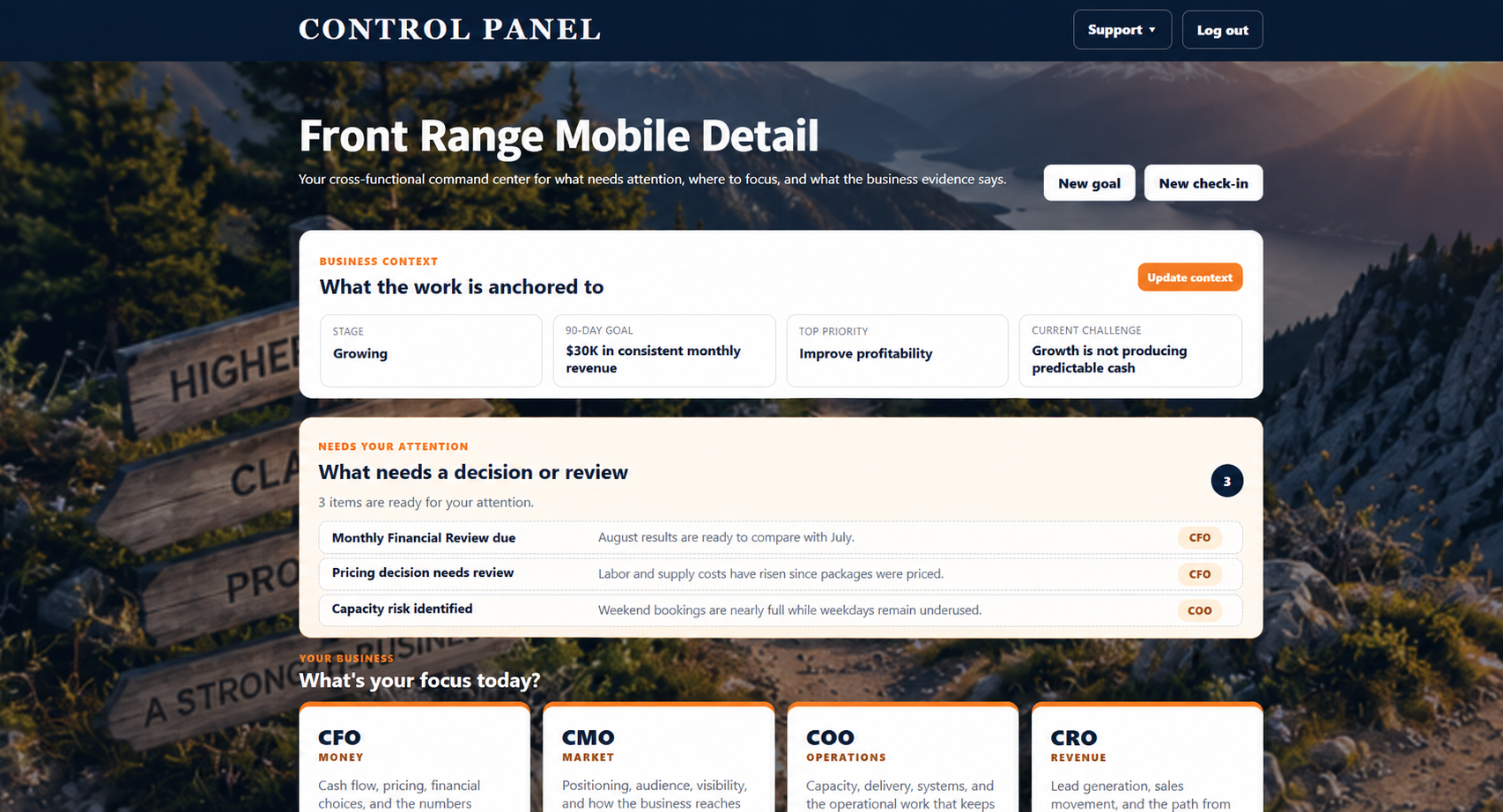
A decision log can help preserve what you expected and what actually happened. That record makes the next startup growth strategy decision more grounded, and helps distinguish a useful test from activity that merely feels productive.
The decision: make the next quarter informative
A weak quarter does not automatically mean you should stop, and it does not justify spending as if demand were already proven. Decide first whether the main constraint is demand, cash, or delivery. Then commit to the smallest test that can clarify it, and agree in advance on what result would change your next move.
That is a more useful first-time founder roadmap than “just go for it.” It respects the fact that first-generation founders may have fewer chances to absorb a miss, and protects the chance to learn from one.
For the operating logic behind this approach, PPG’s RMAE™ methodology connects customer, value, delivery, and organization readiness before a business takes on more growth.
Your next step
You don't need more advice. You need sequence. Take the free 3-minute A.I.D.A. Lite assessment at pinnacleprocessgroup.com and get a Founder Action Plan tailored to where you are right now.
Continue Your Journey
- Free Tools: Work through a specific business decision or task.
- Get Connected: Find education, community, and peer support.
- Support Suite: Keep business context, decisions, and guidance connected over time.
- Get Guidance: Explore practical support for a defined business need.
- Full Engagement: Review PPG’s structured support options for building and implementing the next stage.
Sources
- CB Insights: Why Startups Fail, poor product-market fit was identified in 43% of the post-mortems with classifiable failure reasons.
- Startup Genome Report Extra: Premature Scaling, research finding that premature scaling was associated with 74% of high-growth internet startup failures.