
The Failure Budget: What to Decide Before You Spend Money You Can’t Earn Back
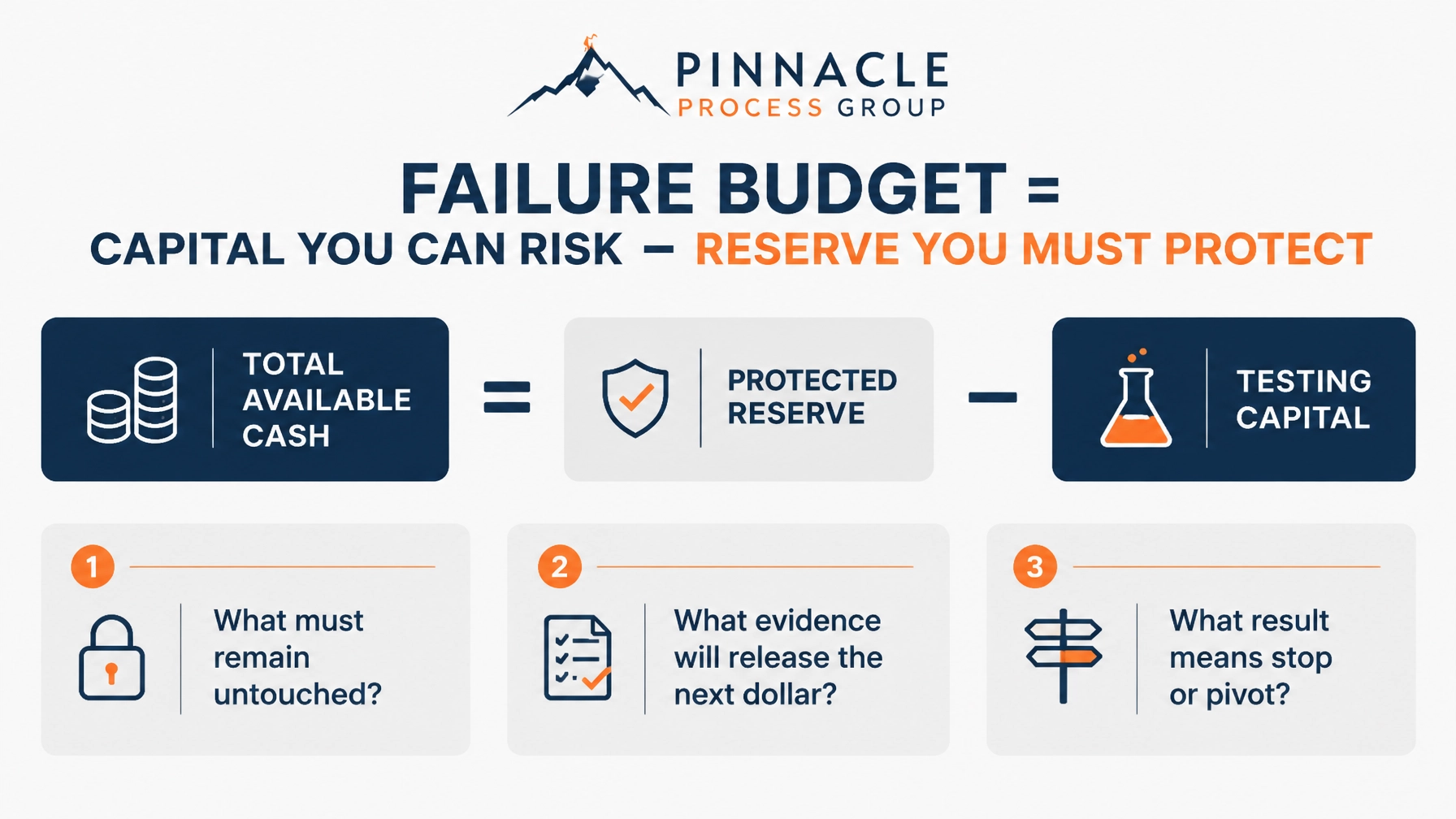
Before you spend the next dollar, decide the maximum amount of cash you can put at risk without damaging your household stability or eliminating your ability to continue earning.
That number is your failure budget.
It is not a prediction that your business will fail. It is a boundary that determines how much you can spend to test the business before you must stop, change direction, or find a different source of capital.
Established companies make versions of this decision constantly. They set pilot budgets, approve capital in stages, hold reserves, and require evidence before releasing more money. If a project fails, the company still has revenue, operating infrastructure, staff, and other lines of business to absorb the loss.
A first-time founder may not have those protections.
A veteran investing separation pay, a single mother using savings, or a displaced worker putting an inheritance into a new business may be risking money that cannot easily be replaced. “Just go for it” is not a strategy when the downside affects housing, childcare, debt obligations, or the ability to recover financially.
The decision is simple to state:
How much failure can you actually afford, and what evidence must appear before you spend more?
Why a failure budget matters
The most expensive mistake is not always spending too much. It is spending without knowing what the money is supposed to prove.
CB Insights’ analysis of startup shutdowns identifies poor product-market fit as a reason in 43% of failures. The finding is important because it points to a market problem, not merely a cash problem. If customers do not need the offer, additional spending will not solve the underlying issue.
The pattern is similar with premature growth. Reporting on Startup Genome research, Business Insider noted that 70% of startups in the study scaled prematurely, and 74% of high-growth internet startup failures were associated with premature scaling. The research connected premature scaling with problems such as hiring too early, building too much product, expanding before demand was repeatable, and increasing costs before the operating model was ready.
These findings do not mean a founder should avoid spending. They mean spending should be connected to a decision.
If you are asking, “Why is my business idea not gaining traction?” the first question is not whether you need a better website, more advertising, or a larger product.
The first question is:
What uncertainty is this next expense supposed to reduce?

Common approaches to startup spending
There are several common ways founders decide how to use limited capital. Each has a reasonable intention. Each also has a predictable weakness.
Spend everything to show commitment
Some founders believe a serious business requires a serious initial investment. They build the full version, purchase professional equipment, commit to a long lease, or hire before demand is clear.
This can work when the business has already validated the customer, offer, price, and delivery requirements. Before that point, it converts assumptions into fixed costs.
Spend as little as possible
A lean approach protects cash by using free tools, personal labor, and informal processes.
That can be appropriate during early discovery. However, extreme cost avoidance can prevent a real test. If customers cannot experience the offer properly, you may learn that the test was weak rather than that the business was wrong.
Borrow or raise money before validation
Outside capital can create room to operate. It can also increase the amount of money that must be justified before the business has reliable evidence.
Capital does not replace market fit. It can extend the time available to find it, but it can also make an unproven model more expensive to change.
Stage the spending
Staged spending treats each expense as a release of capital for a specific milestone. A small amount funds discovery. Evidence from discovery informs the next test. More capital is released only when the previous stage has produced enough information.
This approach does not eliminate risk. It limits the amount of money exposed before the next decision.
For most first-time founders, staging is the most practical starting point.
The enterprise perspective: control the bottleneck
A useful business operations consulting perspective is to treat early spending like an operational control problem.
Enterprise teams often use DMAIC:
- Define the problem or decision.
- Measure the current condition.
- Analyze the likely causes.
- Improve the process or offer.
- Control the result so the improvement holds.
A first-time founder can apply the same logic to a startup growth strategy.
If the bottleneck is unclear customer demand, spending on inventory does not solve the bottleneck.
If the bottleneck is an offer customers do not understand, spending on additional staff does not solve the bottleneck.
If the bottleneck is unreliable delivery, increasing sales may create more complaints, refunds, and rework.
The failure budget should therefore be tied to the current constraint. Each stage of spending should answer one question:
- Who is most likely to buy?
- What problem are they paying to solve?
- What offer will they choose?
- Can the business deliver it consistently?
- Does the price support the work required?
- What must be true before volume increases?
This is also an opportunity-cost decision. Every dollar used for branding, software, equipment, or expansion is a dollar unavailable for customer testing, operating reserves, or correction.
The question is not whether an expense is useful in isolation. The question is whether it is more important than the next unresolved bottleneck.
A first-time founder roadmap for setting a failure budget

1. Set the protected floor first
Start with money that is not available for business experimentation.
Include:
- Essential household expenses
- Minimum debt and tax obligations
- Health, childcare, and transportation needs
- A personal emergency reserve
- The minimum operating cash required to keep existing commitments
This is not your failure budget. It is the amount you protect before calculating what can be risked.
Do not treat the full balance in a savings account as available startup capital simply because it is visible.
2. Define what the first stage must prove
Your first spending stage should have a narrow purpose.
For example:
“I will spend up to $2,000 to determine whether ten customers in this defined segment will pay for this specific offer at this price.”
That is stronger than:
“I will spend $2,000 on launching the business.”
The first statement creates a measurable decision. The second creates activity without a clear result.
3. Divide the budget into release stages
A practical first-time founder roadmap may include four stages:
Stage 1: Customer and problem discovery
Use conversations, observation, pre-sales, or small research activities to test whether the problem is real and important.
Stage 2: Smallest credible offer
Create the simplest version that allows a real customer to buy and use the offer. Do not build features that do not affect the test.
Stage 3: Delivery and economics
Measure the time, materials, support, rework, fulfillment cost, and margin required to deliver consistently.
Stage 4: Controlled growth
Increase marketing, inventory, capacity, or staffing only after demand and delivery show repeatable patterns.
Each stage should have a maximum spend and a decision date.
4. Set evidence thresholds before spending
Evidence does not have to mean a large customer count. It must be relevant to the decision.
Examples include:
- Paid commitments rather than compliments
- Repeat purchases rather than one-time interest
- A defined customer segment responding consistently
- Delivery completed within the expected time
- A price that covers direct costs and required labor
- A reliable lead source that can be measured
The threshold may change by business type. A consulting practice, food business, software product, and construction company will not use the same indicators.
The principle stays the same: define the evidence before the result is emotionally important.
5. Write stop, pivot, and continue rules
A failure budget is incomplete without rules for what happens next.
A continue rule might be:
“If five of eight paid customers complete the first engagement and the work meets the target margin, release the next stage of capital.”
A pivot rule might be:
“If customers confirm the problem but reject the current offer, test a different package or segment before building more.”
A stop rule might be:
“If the full testing budget is spent without paid demand or a clear customer pattern, stop spending and reassess the business model.”
These rules protect you from making decisions based only on sunk costs.
6. Review the budget as a living document
Your failure budget should change when evidence changes.
Review:
- Cash remaining
- Actual monthly burn
- Results from each test
- New obligations
- Delivery performance
- Customer behavior
- The next unresolved bottleneck
A budget that is never updated is only a document. A budget that changes the next decision is a management tool.
Decision summary
Before you spend money you cannot easily earn back:
- Protect the cash required for personal and operating stability.
- Define the maximum amount you can risk.
- Assign each stage of spending one specific learning objective.
- Release capital in milestones rather than as one lump sum.
- Measure customer demand, delivery capability, and economics together.
- Set stop, pivot, and continue rules before you become attached to the result.
- Scale only when the business can support more volume without hiding a bottleneck.
A failure budget is not permission to fail carelessly. It is a way to make uncertainty affordable.
You do not need to prove commitment by spending everything available. You need to buy the right evidence, in the right order, while protecting your ability to continue.
You don't need more advice. You need sequence. Take the free 3-minute A.I.D.A. Lite assessment at pinnacleprocessgroup.com and get a Founder Action Plan tailored to where you are right now.