The Advice That Works for Everyone Works for No One
The decision is not whether to follow business advice.
The decision is whether the advice fits your business well enough to apply as written.
That distinction matters because most business advice is designed for a broad audience. It is meant to be useful across industries, stages, business models, and resource levels. That makes it accessible. It also makes it incomplete.
“Talk to customers.”
“Build an MVP.”
“Raise capital.”
“Improve your marketing.”
“Hire before you are overwhelmed.”
Each statement may be reasonable. None tells you whether it is the right move for your business this week.
The missing ingredient is context.
The Best Option Is Usually Out of Reach
The ideal solution for a founder is straightforward: bring in an experienced operations expert who can work inside the business, understand how the pieces interact, identify the real constraint, and design a solution around the company’s actual conditions.
That is what business operations consulting should do at its best.
An embedded operator does not simply hand over a checklist. They examine the business model, customer reality, delivery capability, financial limits, decision history, and near-term objectives. Then they help determine what should happen next and what should wait.
Fortune 500 enterprises pay for this kind of capability because generic recommendations are not enough when the cost of a wrong decision is high.
Most early-stage founders cannot afford a full-time operating expert or a large consulting engagement. That creates the gap.
The practical alternative is do-it-yourself research. In theory, that should work. The information is available through books, podcasts, courses, templates, newsletters, and online communities.
In practice, the volume of advice creates another problem: founders receive thousands of credible recommendations without the operating context required to choose between them.
The result is not a lack of information.
It is a lack of fit.
Generic Advice Is Usually a Principle, Not a Plan
Research on startup failure shows recurring patterns. CB Insights’ analysis of 431 VC-backed companies found that running out of capital was cited in 70% of shutdowns, while poor product-market fit appeared in 43%, bad timing in 29%, and unsustainable unit economics in 19%.
Those findings are useful. They tell us what tends to go wrong across a large population.
They do not tell a specific founder whether to reduce spending, change the offer, adjust pricing, pursue a different customer segment, or pause growth.
The same pattern appears in broader startup research. Harvard Business Review’s analysis of startup failure emphasizes that failure is not always explained by a weak product or an ineffective founder. Timing, business model design, market conditions, and execution choices interact.
That is the point generic advice cannot resolve by itself.
“Watch your cash flow” is sound advice. But what does it mean for:
- A local service business with inconsistent invoices?
- A software company with a long enterprise sales cycle?
- A product business carrying too much inventory?
- A consultant whose main constraint is available delivery capacity?
- A founder whose offer is profitable but difficult to explain?
The principle is the same. The operating decision is not.

Four Common Approaches
There are several ways founders typically try to close this gap.
1. Hire an embedded operator
This is the strongest option when the business can support it.
An experienced operator can observe the business over time, connect decisions across functions, and build solutions around actual evidence. The limitation is cost. A founder may need that level of support before the business can reasonably pay for it.
2. Follow general advice independently
This is the most accessible option.
A founder can learn the basics of strategic business planning, lean startup methodology, financial management, marketing, sales, and operations without paying for a consultant. That knowledge is valuable.
The limitation is application. Most resources explain what a healthy business commonly does. They do not diagnose which problem is currently limiting your business.
3. Buy a template or course
Templates can reduce the time required to create a budget, plan, dashboard, or customer interview guide.
They are most useful when the founder already understands the decision behind the document. A template can organize thinking. It cannot determine whether the assumptions entered into it are relevant or whether the priority is correct.
4. Copy a successful business
This approach is attractive because it appears concrete. Someone else did something, grew, raised money, or built a profitable company. The founder copies the visible tactic.
The problem is that the visible tactic is rarely the complete explanation. The successful business may have had a different customer, distribution channel, capital base, cost structure, timing, or operational capability.
Copying the action without understanding the mechanism is not a small business growth strategy. It is imitation.
The Enterprise Perspective: Diagnose Before You Improve
Operational excellence starts with identifying the problem correctly.
In a Lean Six Sigma environment, DMAIC provides a disciplined sequence:
- Define the problem.
- Measure the current condition.
- Analyze the likely causes.
- Improve the process.
- Control the result.
The sequence is valuable because it prevents a common mistake: improving the wrong thing.
If sales are weak, the bottleneck may be demand. It may also be unclear positioning, a slow response process, poor qualification, weak follow-up, pricing, or a delivery model that makes the offer difficult to sell.
If the founder is overloaded, the answer may not be hiring. The bottleneck could be unnecessary customization, poor scope control, duplicated work, or a service that is not economically viable.
If revenue is growing but cash is tightening, more sales may make the situation worse. The constraint could be payment timing, gross margin, inventory, or labor capacity.
This is where opportunity cost matters.
Every hour spent applying a generic recommendation is an hour not spent investigating the constraint that may matter most. A founder who spends three weeks redesigning a website may be avoiding a pricing problem. A founder who builds a complex operating system may be avoiding a customer discovery problem.
The work can look productive while moving the business no closer to a decision.
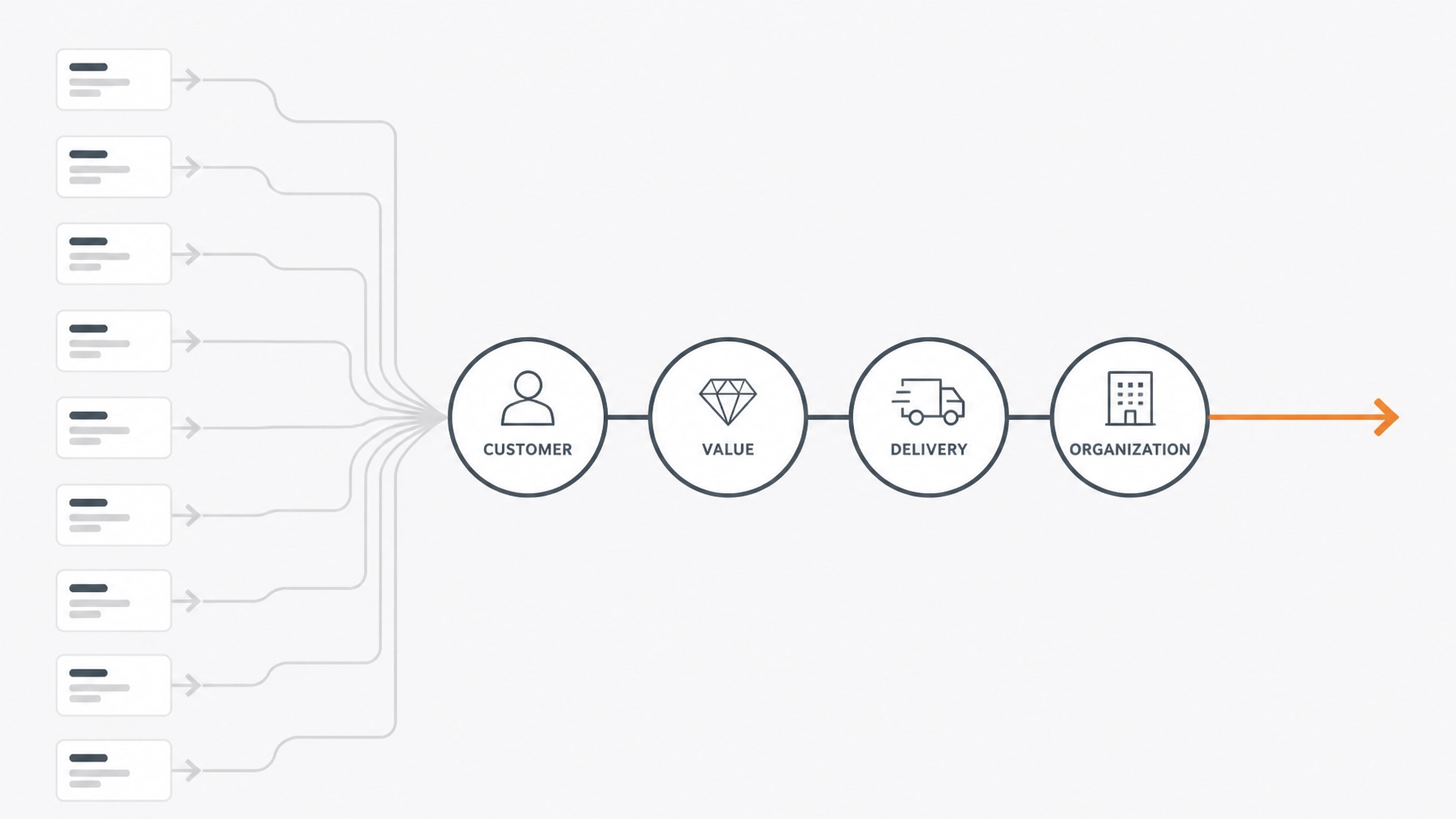
PPG’s methodology uses four connected dimensions to assess whether a business is becoming market-ready:
- Customer: Who specifically is the business serving?
- Value: Why would that customer choose this option?
- Delivery: What can the business reliably fulfill now?
- Organization: Can the structure support real growth?
These dimensions do not operate independently. A change in one affects the others.

A Practical Framework for Deciding Whether Advice Fits
Before applying any business recommendation, run it through four questions.
1. What type of business is this?
Separate the business model from the industry.
A venture-backed software company, a local contractor, a productized service, and a professional practice may all call themselves startups. Their constraints are different.
Ask:
- How does money enter the business?
- What must be true before the next sale?
- What does delivery require?
- Which costs are fixed and which are variable?
- Is growth limited by demand, capacity, capital, or time?
Advice about fundraising may fit one model and distract another. Advice about automation may help a repeatable process but create unnecessary work in a highly customized service.
2. What stage is the business actually in?
Do not use labels such as “early stage” or “ready to scale” without evidence.
A business testing an idea has different needs from one with repeat customers. A business with repeat customers has different needs from one with reliable margins and a repeatable delivery process.
The lean startup methodology is often reduced to “build, measure, learn.” The important question is what you are measuring and what decision the result will inform.
Before scaling, determine whether the business has evidence of:
- A defined customer with a real problem
- An offer customers understand
- Willingness to pay
- Reliable delivery
- Economics that improve or hold as volume increases
3. What is the current constraint?
Choose the one condition that most limits progress right now.
It may be:
- Customer demand
- Offer clarity
- Cash
- Capacity
- Quality
- Time
- Compliance
- Founder decision-making
Do not choose the constraint because it is the most visible issue. Choose it because resolving it would unlock the next meaningful step.
4. What evidence would change the decision?
Advice should produce a test, not just an activity.
“Talk to customers” becomes useful when you define who to speak with, what assumption you are testing, what question you need answered, and what result would change the offer.
“Improve operations” becomes useful when you identify the process, measure the delay or defect, determine the likely cause, and define the improvement target.
“Create a growth plan” becomes useful when it connects a specific objective to available cash, capacity, customer demand, and a sequence of decisions.

Decision Summary
The advice that works for everyone is usually a broad principle.
It is not necessarily wrong. It is simply not specific enough to act on without interpretation.
Use general guidance to identify possibilities. Do not treat it as a prescription. First determine your business model, actual stage, current constraint, and available evidence. Then adapt the recommendation into one testable action.
The right small business growth strategy is not the one that sounds most impressive. It is the one that addresses the constraint your business can prove it has.
That is also the distinction between learning about operational excellence for startups and building operational discipline inside a real company.
A Trail Marker is the appropriate PPG solution for this decision: a focused diagnostic that helps identify where to concentrate before investing in a larger plan or engagement.
Continue Your Journey
- Free Tools : Practical tools for one business question or task.
- Get Connected : Education, community, networking, and peer support.
- Support Suite : Business-specific context and connected decisions over time.
- Get Guidance : Focused business assets built for your actual needs.
- Full Engagement : Deeper support when the business requires a connected operating plan.
Ready to stop cycling through generic advice? Take the free A.I.D.A. Lite assessment at pinnacleprocessgroup.com. Your report will show you exactly where to focus next : then register for the next Basecamp Workshop or email your questions to admin@pinnacleprocessgroup.com.